“Nothing is more depressing than a habitual environment. The splendid view had become as flat and dull as a picture postcard.” —Vladimir Nabokov, Speak, Memory (1951)
“No man ever steps in the same river twice.” —Heraclitus (c. 500 BCE)
“To gain anything we have longed for is only to discover how vain and empty it is” —Arthur Schopenhauer, The Vanity of Existence (1850)
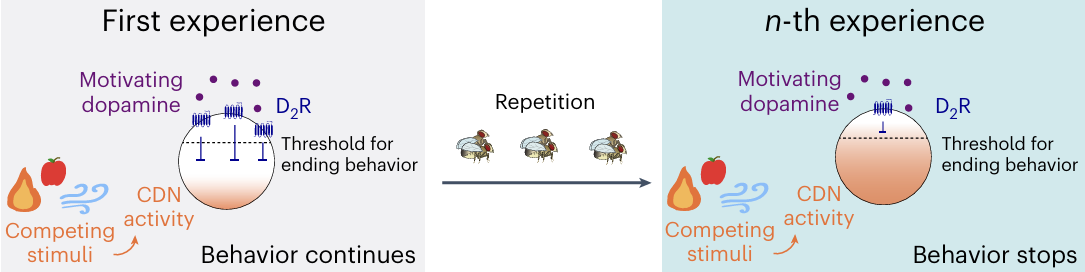
Why are we less enthusiastic when doing things the 2nd, 3rd, 4th time around? Why is it never as good as the first time? We asked the male fly, who we found to be far less motivated to endure threats that occur during 2nd, 3rd, or 4th matings. During mating, dopamine acts on a group of neurons called the Copulation Decision Neurons (CDNs) that are activated by threats and other challenges that arise. Dopamine shortens the amount of time that information from threats and challenges can linger in the CDNs and cause the male to end the mating early. So less dopamine signaling means more responsiveness to threats. But we found that that the same dopamine that motivates males on the current mating also causes a lasting desensitization of the receptor. So the next time around the same dopamine hits less. This is essentially what happens in drug addiction, where elevated levels of dopamine desensitize all of the receptors everywhere, so you need more drug to get the same effect and non-drug stuff that you were previously motivated to do becomes devalued. But here we see that mechanism working on circuits that control individual behaviors and in response to naturally released dopamine. So we’re pretty sure this is how most behaviors get devalued by repetition in humans and other animals.
Here’s a link to the paper. Here are some news stories about it: